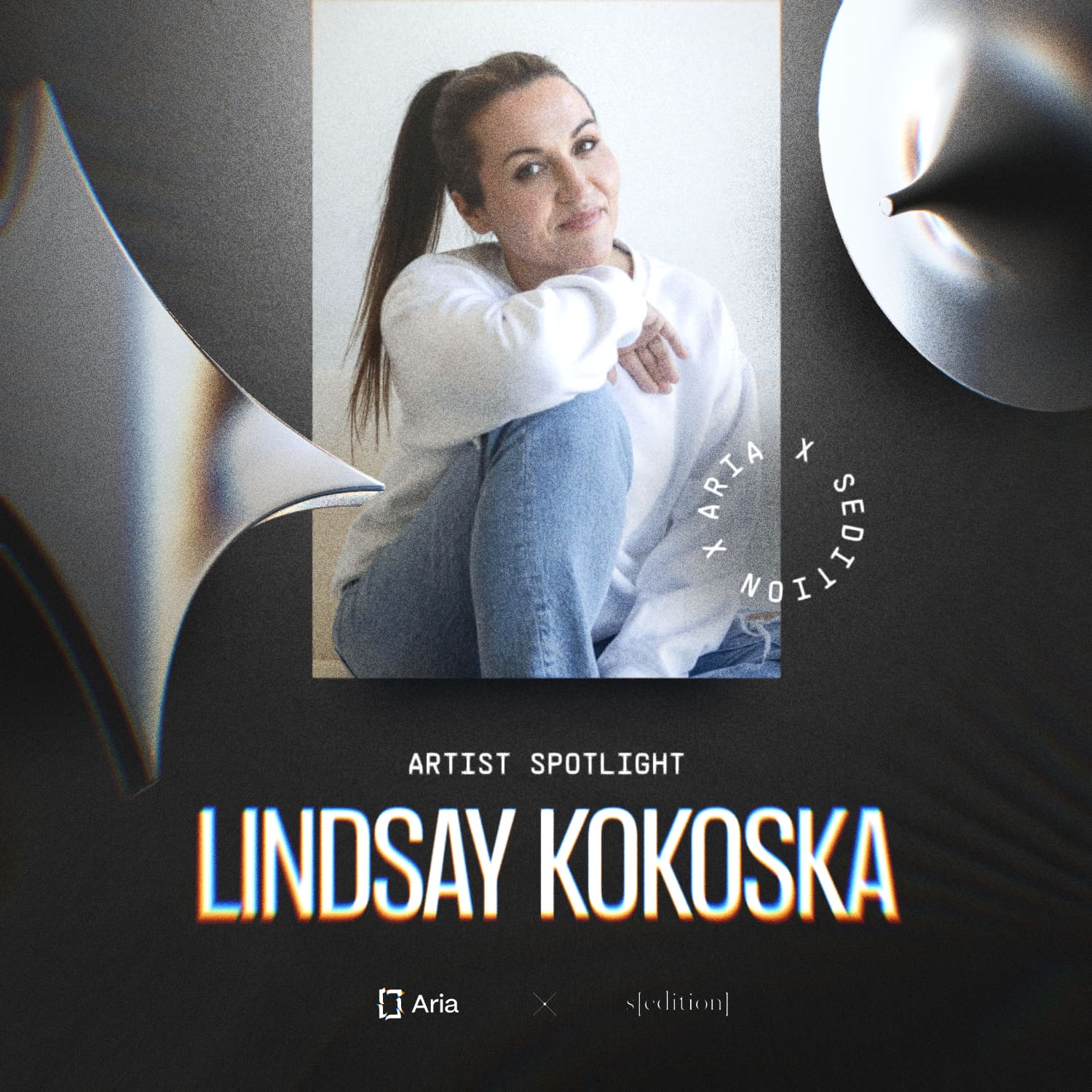
About the artist:
Lindsay Kokoska is a Canadian multimedia artist and founder of Infinite Mantra Art Studio. She works across traditional and digital mediums, blending painting, fine art compositing, animation, and AI to create abstract, surreal, and figurative environments inspired by the cosmos, inner awareness, and the unseen layers of human experience. Her pieces explore other dimensions, consciousness, meditation, and abstract forms through dreamlike imagery and contemporary digital processes.
Her visual language moves between abstraction, surreal elements, and subtle figurative forms, often carrying a quiet transcendental quality. Through movement, color, and layered composition, her work invites viewers to pause, shift perspective, and connect with a deeper part of themselves. She aims to create spaces that evoke reflection and allow people to recognize the magic that already exists in their own lives.
With a background in education and marketing, Lindsay holds a Master’s degree in Graphic Art and has studied at the Toronto School of Art, along with independent studies in Bali. Her practice has grown through a mix of formal study and years of self directed experimentation across both traditional and digital mediums. She believes in the open possibilities of creativity and encourages viewers to explore the connections between their material and inner experiences.
Midnight Bloom by Lindsay Kokoska
The Interview:
Paloma: Your work often explores human consciousness, alternate dimensions, and inner transformation. How do these themes shape your creative process, and what do you hope viewers access within themselves when engaging with your work?
Lindsay: My work is driven by an interest in what it means to be human beneath the surface of everyday life. I am drawn to ideas of inner change, memory, emotion, and the possibility that there is more to our perception than what we see at first glance. When I create, I treat each piece like a passage from one state to another, almost like a visual shift in awareness.
I hope viewers feel a moment of pause. If the work allows them to slow down, reflect, or feel a sense of inner space, then it has done its job. I am not trying to tell people what to think. I am offering a visual environment where they can recognize something within themselves.
P: As an artist working across both traditional and digital mediums, how do you think about authorship, ownership, and the evolving role of IP ?
L: Working across traditional and digital mediums has made authorship feel more expansive, not less. For me, authorship is rooted in intention, vision, and creative decision making. Tools may change, but the voice behind the work remains constant.
Ownership and IP are becoming more important as art moves into digital ecosystems. I believe artists should have clear rights, protection, and transparency as their work circulates across new platforms and formats. Digital art allows for distribution at scale, but it also requires a thoughtful approach to how artists are credited, compensated, and represented. I see IP not as a limitation, but as a framework that supports long-term value for both artists and collectors.
P: You’ve been an early adopter of platforms like Sedition that allow art to be collected, streamed, and experienced digitally. What first drew you to this model, and how has it changed the way you imagine the life of your artwork or artwork generally beyond the studio?
L: I was drawn to Sedition because it offered a way for art to live beyond a single wall, location, or moment. The idea that a piece could be collected, shared, and experienced across different environments felt exciting and aligned with the way people consume visual culture today.
It changed how I think about the lifespan of an artwork. Instead of a static object that stays in one place, a digital piece can evolve through context, scale, format, and audience. It becomes part of a living ecosystem. It can travel, be displayed publicly or privately, and reach people who may never step into a gallery. That expanded the way I imagine impact and accessibility.
P: What continues to attract you to digital-first platforms like Sedition? Is it the accessibility, the community, the technology or something more philosophical about how art should live in the world?
L: Accessibility is a big part of it. Digital platforms remove barriers. People from anywhere can collect and engage with art, not only those who live near cultural hubs. There is also a sense of community. Viewers and collectors are curious, open, and engaged with new ways of experiencing art.
There is also a broader idea at play. Digital platforms allow art to be fluid. It can move, scale, and coexist with technology in a way that feels current. It allows art to live in motion rather than be confined to a single physical format.
P: Your art often feels like a portal or an invitation to pause, shift perspective, or look inward. How does this influence the stories you choose to tell within each piece, and how do you hope your work is experienced, whether through Sedition or by collectors and viewers more broadly?
L: When I create a piece, I start with mood and emotion rather than a literal narrative. I think of each artwork as a space the viewer can enter rather than an image to simply observe. Light, texture, and movement play a big role in shaping that feeling of crossing into a different inner landscape.
Whether on Sedition or in a collector’s home, I hope the experience feels personal. The work is not about answers. It is about possibility. If someone feels a shift in perspective, a sense of calm, curiosity, or openness, then the piece has completed its purpose.
These artworks by Lindsay are now streaming on Sedition worldwide and can be found on the “Curated by Aria” сhannel.
